PTc
Preterm control pattern
FEV₁ ≥ LLN
FEV₁/FVC ≥ LLN
This is the preserved physiological reference pattern among preterm-born participants.
RHiNO research has helped show that respiratory disease after preterm birth is heterogeneous. Rather than relying on symptoms or neonatal labels alone, the PLD framework asks what current physiological pattern an individual has, how it arose, whether it is reversible, and how it may evolve with growth.
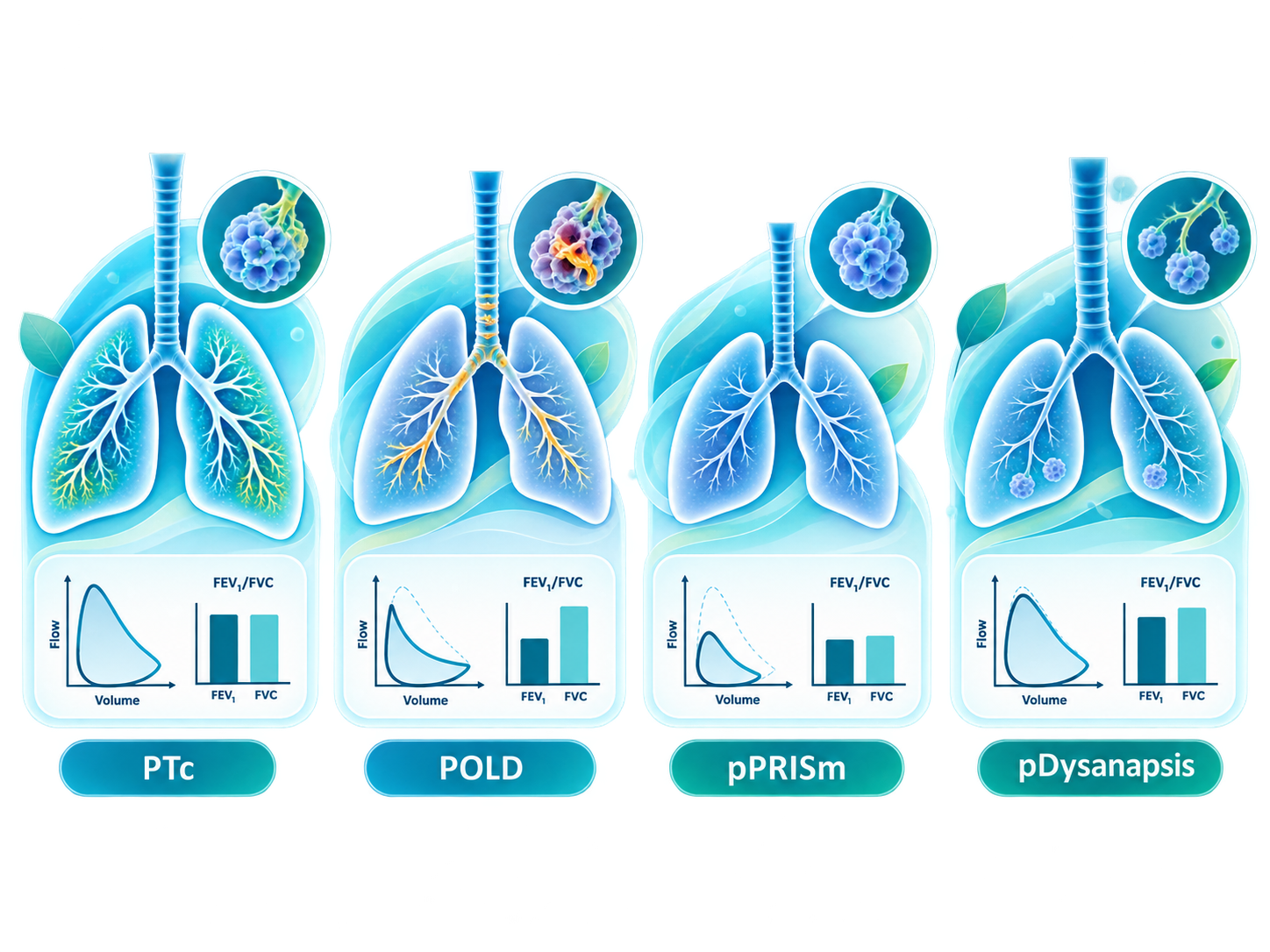
Bronchopulmonary dysplasia (BPD) remains an important neonatal diagnosis, but it does not fully capture the diversity of later respiratory abnormalities seen in children and adults born preterm. RHiNO work therefore uses the concept of prematurity-associated lung disease (PLD) to describe later respiratory impairment more broadly and more physiologically.
A practical way to classify later respiratory physiology after preterm birth is to consider whether FEV₁ and FEV₁/FVC are above or below the lower limit of normal (LLN). This yields one preterm control pattern and three abnormal phenotypes.
FEV₁ ≥ LLN
FEV₁/FVC ≥ LLN
This is the preserved physiological reference pattern among preterm-born participants.
FEV₁ < LLN
FEV₁/FVC < LLN
An obstructive pattern suggesting airflow limitation, with potential links to later chronic obstructive disease.
FEV₁ < LLN
FEV₁/FVC ≥ LLN
Reduced expiratory volume despite a preserved ratio, implying physiology distinct from classical obstruction.
FEV₁ ≥ LLN
FEV₁/FVC < LLN
A pattern compatible with airway–lung size mismatch, where ratio is reduced despite preserved FEV₁.
Different phenotypes may arise from different developmental abnormalities in airways, alveoli or airway–lung matching.
Bronchodilator responsiveness is not uniform across PLD phenotypes, so “abnormal lung function” is not a sufficient treatment guide.
Some physiological patterns may be more stable over time, while others may transition as lungs continue to grow.
A phenotype-based framework creates a more rational route to treatment, monitoring and future interventional research.
Single-dose bronchodilator testing has shown that a substantial proportion of abnormal pre-bronchodilator spirometry moves into the preterm-control range after treatment. Importantly, this reclassification differs across phenotypes, suggesting that the reversibility of PLD is heterogeneous.
A child born preterm with abnormal spirometry should not automatically be assumed to have fixed impairment. Phenotyping and bronchodilator testing provide more clinically meaningful information than a single uncontextualised FEV₁ measurement.
The most important question is increasingly not simply whether lung function is abnormal, but how a phenotype changes over time. RHiNO is therefore increasingly focused on longitudinal stability, transition between phenotypes, and the relationship between childhood physiology and later respiratory health.

A phenotype-based PLD framework supports more precise follow-up and future treatment studies. It also provides a bridge between neonatal respiratory history, childhood physiology and adult lung-health research.
This is one reason why PLD and its phenotypes were brought together in the 2026 Lancet Respiratory Medicine Series.
The broader scientific story from symptoms to mechanisms and trajectories.
Explore →History, assessments, trial work, imaging and longitudinal programme development.
Explore →The full RHiNO research library, including the 2026 PLD Series.
Browse →The children and families whose involvement made these insights possible.
Explore →Azithromycin Therapy for Chronic Lung Disease of Prematurity
Visit AZTEC ↗Preventing respiratory infections after discharge
Visit BALLOON ↗Respiratory Health Outcomes in Neonates
RHiNO home →