Looking beyond bronchopulmonary dysplasia: prematurity-associated lung disease and its phenotypes
Defines the PLD framework and describes physiological phenotypes including POLD, pPRISm and pDysanapsis.
PubMed ↗RHiNO has developed from population studies of respiratory outcomes after preterm birth into a broad research programme spanning PLD phenotypes, treatment, lung physiology, imaging, exercise, environment, mechanisms and lifelong respiratory trajectories.
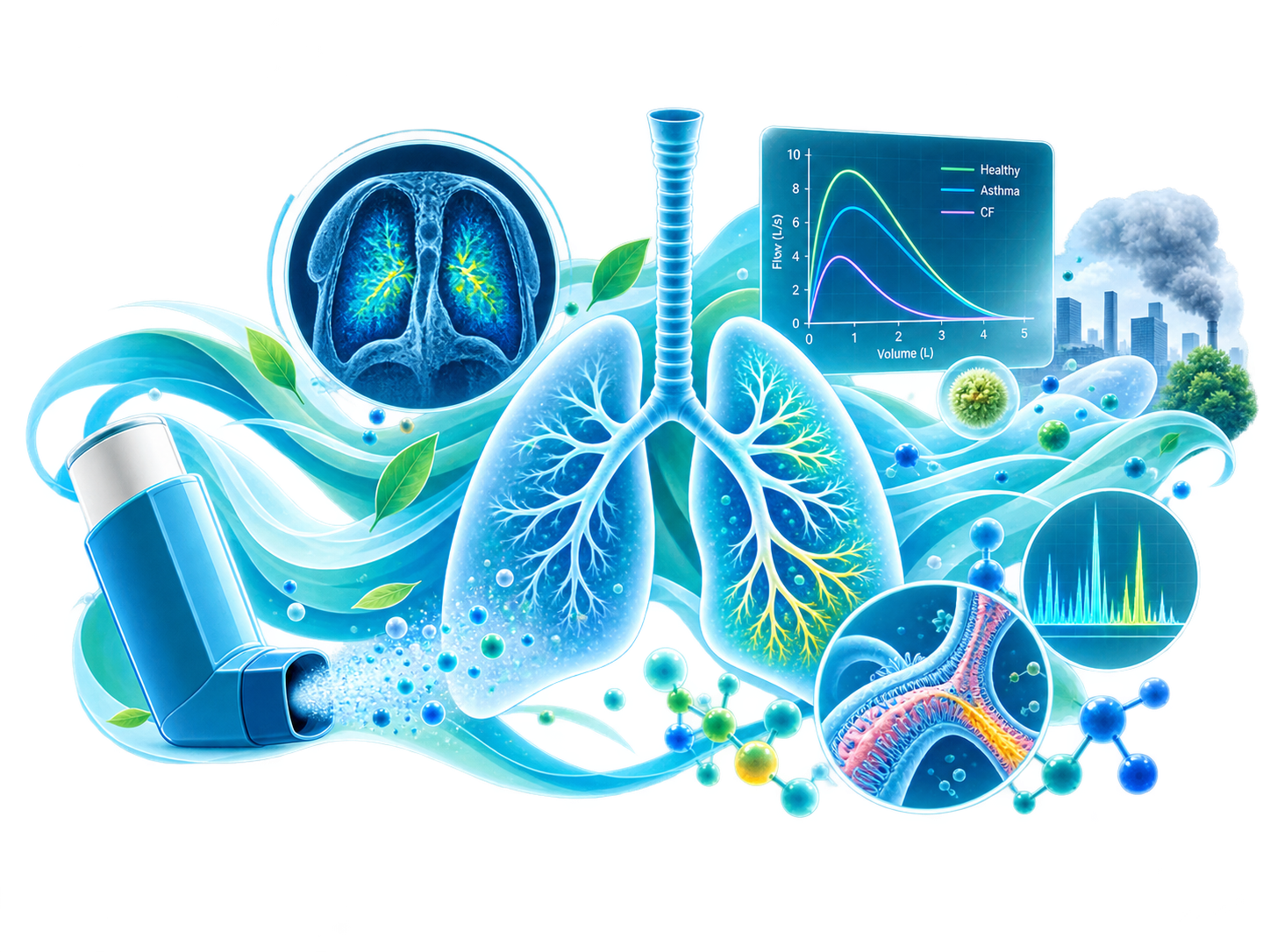
The three-paper Series synthesises the emerging field of prematurity-associated lung disease across the life course: defining PLD and its phenotypes, understanding lifelong lung-function trajectories, and considering management from infancy through adulthood.
Defines the PLD framework and describes physiological phenotypes including POLD, pPRISm and pDysanapsis.
PubMed ↗Brings together longitudinal evidence on how respiratory physiology evolves after preterm birth.
PubMed ↗Reviews assessment, treatment and prevention strategies across the life course.
PubMed ↗Each paper includes a short explanation of why it matters. The library can be searched by title, author, journal or topic, and filtered by scientific theme.
43 publications and reviews are represented in this library.
Lancet Respiratory Medicine
Synthesises evidence on how lung function evolves after preterm birth from childhood into adult life. It highlights heterogeneous trajectories and the need for longitudinal surveillance to identify individuals at risk of persistent obstruction or early COPD.
PubMed / source ↗Lancet Respiratory Medicine
Reviews management across the life course, from early respiratory symptoms to adult disease. It emphasises phenotype-aware assessment, treatment of reversible components, prevention of additional lung injury and the need for better trial evidence.
PubMed / source ↗Lancet Respiratory Medicine
Defines PLD as a broader life-course concept than neonatal BPD and describes physiological phenotypes including POLD, pPRISm and pDysanapsis. The paper argues that phenotype-based follow-up may better reflect later respiratory health and support more targeted care.
PubMed / source ↗Current Treatment Options in Pediatrics
Reviews contemporary approaches to BPD prevention and treatment. It places neonatal management in the wider context of improving survival while reducing long-term respiratory morbidity.
PubMed / source ↗European Respiratory Review
Shows that exercise limitation after preterm birth is not explained by spirometry alone. Across cohorts, abnormalities can involve ventilatory, cardiovascular and metabolic responses, supporting cardiorespiratory fitness as an important life-course outcome.
PubMed / source ↗European Respiratory Review
Systematically evaluates physiological abnormalities beyond standard spirometry after preterm birth. The findings broaden the PLD phenotype by examining lung volumes, gas transfer and oscillometric measures of airway mechanics.
PubMed / source ↗ERJ Open Research
Uses detailed respiratory mechanics to probe differences between PLD phenotypes beyond conventional spirometry. The study supports the biological distinctness of the physiological groups and helps refine mechanistic phenotyping.
PubMed / source ↗Lancet Respiratory Medicine
Integrates evidence from childhood through adulthood to show that preterm birth can establish altered respiratory trajectories that persist for decades. The review links developmental lung injury with later chronic respiratory risk.
PubMed / source ↗Thorax
Examines air pollution as a potentially modifiable exposure in children whose lung development was interrupted by preterm birth. The work supports incorporating post-discharge environmental exposures into models of PLD risk.
PubMed / source ↗Scientific Reports
Metabolomic profiling identified disturbances in POLD that overlap with pathways reported in COPD, including oxidative-stress and energy-metabolism pathways. The similarities raise questions about shared mechanisms and future chronic obstructive risk.
PubMed / source ↗Translational Pediatrics
Editorial perspective on how increasing recognition of PLD should change clinical management. It highlights the gap between established asthma pathways and the distinct physiology seen after preterm birth.
PubMed / source ↗Paediatric Respiratory Reviews
Reviews why adherence is often suboptimal in paediatric respiratory disease and how it can be assessed and improved. The topic is highly relevant when evaluating whether apparent treatment failure reflects biology, delivery or adherence.
PubMed / source ↗Scientific Reports
Investigates epithelial/desmosomal biology in children with a history of BPD and whether inhaled treatment modifies associated molecular signals. The work links clinical intervention with potential airway structural mechanisms.
PubMed / source ↗American Journal of Respiratory and Critical Care Medicine
Uses hyperpolarised xenon MRI and multiple-breath washout to reveal regional ventilation and gas-exchange abnormalities after preterm birth. Advanced imaging exposes heterogeneity not fully captured by global spirometry.
PubMed / source ↗Journal of Pediatrics
Extends the RHiNO programme beyond the lungs by examining cardiovascular consequences of prematurity and fetal growth restriction. It highlights the shared developmental origins of later cardiopulmonary health.
PubMed / source ↗PLOS ONE
Examines telomere length as a potential marker of biological ageing in children born preterm and relates it to early and current exposures. It addresses whether developmental adversity leaves measurable long-term cellular signatures.
PubMed / source ↗Lancet Respiratory Medicine
An early conceptual paper arguing that later respiratory disease after preterm birth should not be reduced to a history of BPD. It helped establish the terminology and rationale that subsequently developed into the PLD phenotype framework.
PubMed / source ↗JAMA Pediatrics
Author reply discussing interpretation of the RHiNO inhaler trial and the remaining uncertainties. It underscores the need to identify which PLD phenotypes benefit most and how treatment should be translated into practice.
PubMed / source ↗JAMA Pediatrics
The RHiNO randomised trial demonstrated a clinically important improvement in lung function with combined ICS/LABA in selected preterm-born children with reduced FEV1. It provides direct evidence that part of PLD is modifiable with inhaled therapy.
PubMed / source ↗Pediatric Pulmonology
Shows impaired exercise performance in children with POLD and examines bronchodilator responsiveness during physiological assessment. The findings connect airflow obstruction with functional limitation and potentially treatable physiology.
PubMed / source ↗JAMA Pediatrics
Meta-analysis showing that later FEV1 after preterm birth varies across geography and birth eras. The work suggests respiratory outcomes are influenced not only by gestation but also by changes in neonatal care and population context.
PubMed / source ↗European Respiratory Journal
Links neonatal and early-life characteristics with school-age PLD. The analysis shows that later respiratory impairment reflects a combination of developmental and perinatal factors rather than BPD status alone.
PubMed / source ↗Journal of Breath Research
Systematically reviews volatile organic compounds as non-invasive biomarkers in newborn disease. The work explores whether breath-based chemical signatures could support early diagnosis or phenotyping in neonatal medicine.
PubMed / source ↗European Respiratory Journal
Examines how infant catch-up growth relates to later wheezing patterns. It contributes to the developmental model in which postnatal growth can modify respiratory outcomes after an adverse start to life.
PubMed / source ↗Pediatric Pulmonology
Evaluates FeNO after preterm birth to test whether airway inflammation resembles conventional eosinophilic asthma. The findings help distinguish PLD biology from asthma and inform interpretation of inhaled corticosteroid response.
PubMed / source ↗American Journal of Epidemiology
Compares determinants of wheezing phenotypes in preterm and term-born children. It demonstrates that apparently similar respiratory symptoms can arise from different developmental backgrounds and risk structures.
PubMed / source ↗Revista Médica Clínica Las Condes
Reviews the respiratory consequences of preterm birth beyond infancy. It summarises persistent symptoms, lung-function impairment and the emerging concern about future chronic obstructive disease.
PubMed / source ↗Paediatric Respiratory Reviews
Reviews links between fetal growth, infant growth, body composition and later respiratory outcomes. It places lung development within a wider developmental-origins framework.
PubMed / source ↗Pediatric Pulmonology
Examines fetal and early postnatal growth as determinants of later respiratory symptoms. The study supports the importance of growth restriction and growth trajectories in long-term lung health.
PubMed / source ↗Breathe
Reviews sex-related differences in respiratory outcomes after preterm birth. It considers whether biological sex modifies vulnerability during lung development and subsequent respiratory morbidity.
PubMed / source ↗Welsh Paediatric Journal
Describes practical and professional aspects of moving from clinical nursing into research delivery. It reflects the multidisciplinary infrastructure required to conduct detailed paediatric cohort and intervention studies.
PubMed / source ↗Minerva Pulmonology
Review of the spectrum of respiratory outcomes after preterm birth, emphasising that morbidity persists beyond the neonatal period and requires long-term clinical and research attention.
PubMed / source ↗Paediatric Respiratory Reviews
Reviews physical activity and exercise outcomes after preterm birth. It broadens assessment beyond lung-function numbers to participation, fitness and everyday functional health.
PubMed / source ↗PLOS ONE
Measures physical and sedentary behaviour in children born preterm. It asks whether respiratory and developmental consequences of prematurity translate into altered everyday activity.
PubMed / source ↗PLOS ONE
Examines treatment of wheeze after preterm birth and its relationship with atopy. The study questions whether asthma-style treatment is always biologically appropriate for prematurity-associated respiratory symptoms.
PubMed / source ↗Journal of Pediatrics
Assesses physical activity after preterm birth at school age. The study examines whether developmental lung and health differences translate into measurable differences in habitual activity.
PubMed / source ↗Neonatology
Systematically reviews bronchodilator responsiveness after preterm birth. It provides early evidence that a reversible component of airflow limitation exists in at least some preterm-born individuals.
PubMed / source ↗Journal of Allergy and Clinical Immunology
Shows that respiratory risk is not confined to very preterm birth, with early-term birth also associated with later wheeze. This supports a gestational-age continuum of respiratory vulnerability.
PubMed / source ↗Acta Paediatrica
Identifies higher systolic blood pressure in preterm-born children despite otherwise normal vascular measures. It adds to evidence that prematurity has multisystem cardiovascular as well as respiratory consequences.
PubMed / source ↗Journal of Pediatrics
Examines exercise-induced bronchoconstriction in children with neonatal chronic lung disease. It explores whether exertional symptoms reflect reversible airway narrowing and how this differs from conventional asthma.
PubMed / source ↗Thorax
A foundational meta-analysis showing persistent reduction in expiratory airflow after preterm birth. It helped establish impaired later lung function as a major long-term consequence of prematurity.
PubMed / source ↗Seminars in Fetal and Neonatal Medicine
Reviews evidence that late-preterm birth, despite being relatively close to term, can still have lasting respiratory consequences. It reinforces the concept of respiratory risk across the gestational-age spectrum.
PubMed / source ↗Thorax
Longitudinally examines spirometry after late-preterm birth through school age and adolescence. The study demonstrates that modestly shortened gestation can influence lung-function development well beyond infancy.
PubMed / source ↗Population studies establish the long-term respiratory consequences of preterm birth.
Detailed lung physiology identifies POLD, pPRISm, pDysanapsis and other measurable abnormalities.
Imaging, metabolomics, mechanics and environmental studies investigate why those phenotypes occur.
Randomised and bronchodilator studies test whether abnormal physiology can be modified.
Longitudinal research asks how childhood phenotype influences later respiratory health.
The major findings explained in accessible language.
Explore →The physiological framework behind POLD, pPRISm and pDysanapsis.
Explore →How the cohort was recruited, assessed and followed.
Explore →The people who made the RHiNO research programme possible.
Explore →